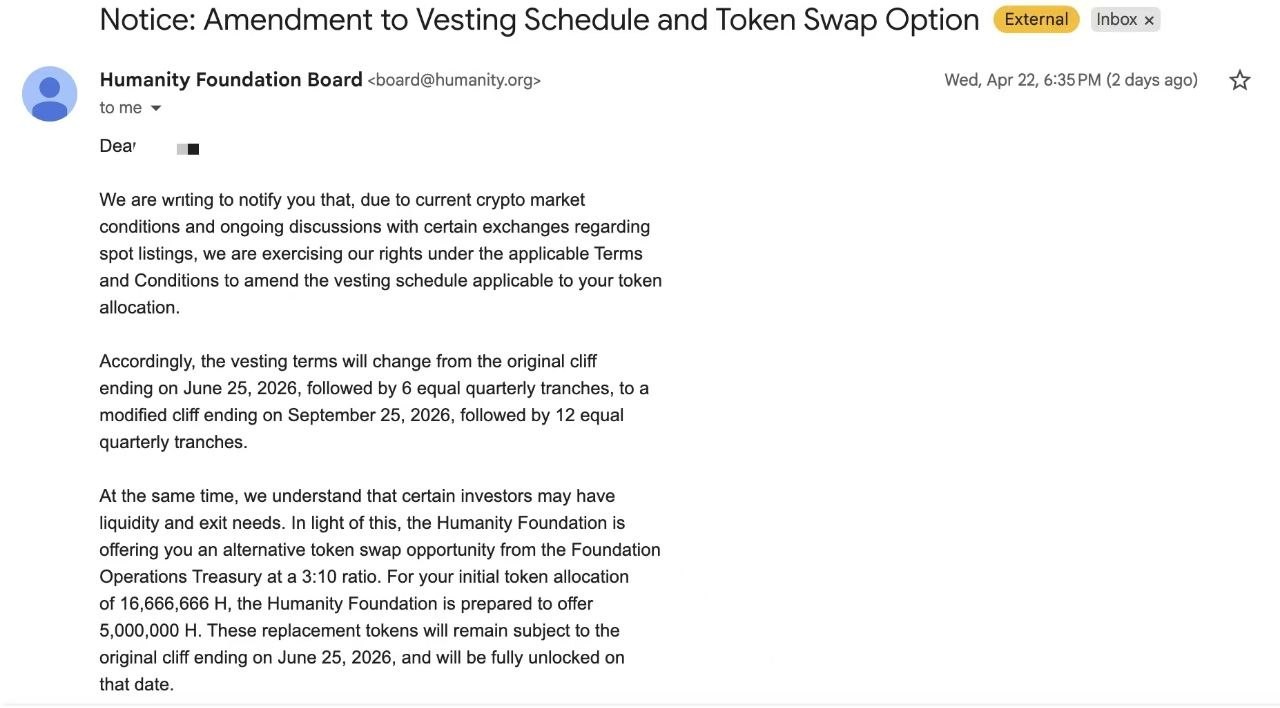
The Humanity Foundation has announced a material revision to the $H token vesting schedule for investors. The original plan — set to begin on June 25, 2026, with six equal quarterly tranches — now requires investors to respond via email by April 26, 2026 at 09:00 UTC, electing between two options: Option 1, an extended vesting schedule with the cliff pushed to September 25, 2026 and distribution extended to 12 equal quarterly tranches; or Option 2, a 3:10 ratio discounted immediate unlock, replacing the original allocation of 16,666,666 $H with 5,000,000 $H (a 70% reduction), fully unlocked on June 25, 2026. Early-stage investor Trix Ventures has publicly disclosed its election of the discounted immediate unlock. The firm reportedly entered at a project valuation of approximately $60 million, and stands to realize roughly a 7x return even after the 3:10 discount.
It is worth noting that Humanity Protocol previously established a deep partnership with payments giant Mastercard, lending traditional financial credibility to its fundamentals. The on-chain identity verification sector remains early-stage in terms of market size, but as AI-generated content and automated accounts continue to proliferate, demand for verifiable on-chain identity is widely expected to grow exponentially. The sector is seen as having the potential to produce a leading infrastructure project in the Web3 space. The project now faces a critical stress test in the form of a concentrated large-scale unlock event — how it weathers this will be a key indicator of whether it can grow alongside the AI sector’s expansion.
1. The 3:10 Immediate Unlock: The Only Rational Exit Under Current Conditions
Despite the severe 70% paper haircut, in the current Web3 bear cycle, “realized liquidity” far outweighs “paper value” — cash is king. The extended schedule locks up liquidity for three years. In an unpredictable market, protocol survivability, technological iteration, and even team continuity three years out are all significant unknowns. Professional investment firms broadly face LP redemption pressure, and the reinvestment value of a secured 30% cash position far exceeds a 100% paper allocation that may be worthless in three years.
2. June 25, 2026 Will Be a “Death Spiral” Stress Test
Electing the 30% option is, in part, about capital recovery and securing a defensible position before a potential stampede.
A massive sell wall: If 80% of investors elect the June 25 unlock, approximately 3.3% of total supply (~330 million $H) will hit the market simultaneously. Institutional frontrunning and hedging: With roughly two months between the April 26 confirmation and the actual June 25 release, institutions with hedging capability will very likely lock in profits via perpetual shorts or DEX borrow-and-sell ahead of time. This “exit-before-expiry” behavior means some investors may have effectively realized their value through hedging well before June 25 — potentially driving the price down by 50% before the unlock even arrives. On-chain hunting: Because the release is administered via Sablier, the unlock schedule is fully transparent to the market. Quant desks and shorting bots will snipe the June 25 release node with precision, using leveraged shorts to lock in profit — putting price under severe downside pressure in the lead-up to the unlock.
3. Liquidity Dry-Up: Market Maker Defensive Withdrawal
Sustaining market liquidity requires active market makers. Once the market has priced in a concentrated large-scale release on June 25 — even at a discounted size — market makers may pull bid depth in advance to avoid being blown through by large sell orders. When investors attempt to exit 5,000,000 $H on an exchange, slippage on orders of that scale could erode realized value to less than 10% of the nominal figure.
4. Historical Lessons
Starknet (STRK): In February 2024, Starknet announced a large-scale unlock just two months post-launch. The plan was widely criticized as aggressive and hostile to secondary market participants, erasing investor trust premium overnight. STRK has since bled over 95% from its all-time high, becoming a textbook “zombie L2.” ApeCoin (APE): $APE similarly involved a large-scale investor unlock, with the market beginning to frontrun the event roughly 30 days in advance. Despite structuring around the vesting event, APE still fell 77% over the following seven months. If the Humanity Foundation unlocks 100% of tokens to 100+ investors on June 25, 2026, quant traders will read it as a “supply nuke.” Even at 50% election, the resulting float will vastly exceed available bid depth. Fixed-value traps: The “haircut exit” precedents set by Vesta Finance (VSTA) and Hope.money remain fresh in market memory.
5. Electing the June 25 Immediate Unlock Is the Prudent Call
For early investors who have already captured gains, electing the June 25 immediate unlock is fundamentally about restoring tokens to freely deployable capital. The Humanity Foundation is understood to have sent this notice to over 100 investors. In a prisoner’s dilemma where every participant fears being last out the door, securing a position at the front of the release queue is the only defensible hedge available.